
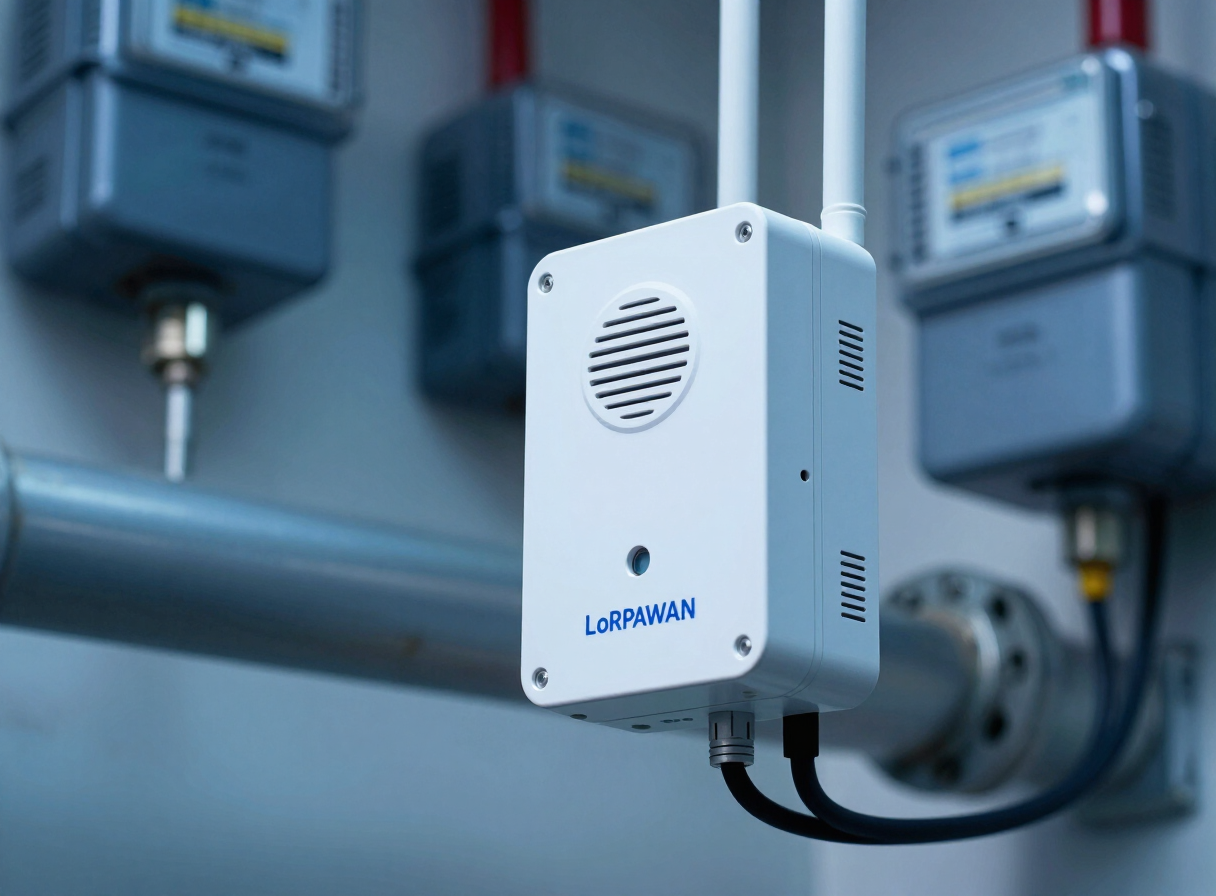
LoRaWAN (Long Range Wide Area Network) is a low-power, long-range wireless protocol designed to connect battery-powered sensors across large areas. For industrial monitoring it hits a sweet spot: kilometres of range, years of battery life, and low cost per sensor.
How LoRaWAN works
Sensors send small packets of data over long distances to gateways, which forward them to a network server and then to your platform. Because the data rate is low and transmissions are brief, sensors sip power — a single battery can last 5 to 10 years.
Why it suits industry
Large sites are expensive to wire. LoRaWAN covers a whole estate with a handful of gateways, penetrates buildings and structures, and adds new sensors without new cabling. That makes instrumenting hundreds of measurement points economically viable.
When not to use it
LoRaWAN is for low-bandwidth telemetry, not video or high-frequency control loops. For those, use wired or cellular. For energy, environmental and condition monitoring, it is ideal.
Frequently asked questions
- What is the range of LoRaWAN?
- LoRaWAN typically achieves 2 to 15 kilometres of range depending on terrain, with strong penetration through buildings and industrial structures, so a few gateways can cover an entire estate.
- How long do LoRaWAN sensor batteries last?
- Because transmissions are brief and infrequent, LoRaWAN sensors commonly run for 5 to 10 years on a single battery.
- When should you not use LoRaWAN?
- LoRaWAN is designed for low-bandwidth telemetry. It is not suitable for video streaming or high-frequency real-time control, where wired or cellular connectivity is required.
Put these ideas to work
Request an infrastructure audit and we will design a monitoring programme built around your estate and objectives.
Choose how you would like to engage our team.
Every route below reaches our UK and EU enterprise engineers directly. Pick the one that fits where you are — no obligation, response within one working day.
Common questions
An engineer reviews your metering estate and site plans, then returns a scoped monitoring proposal — typically within one working day of the initial call. There is no cost or obligation.
Send an enquiry
Tell us about your estate and we will route you to the right engineer.