
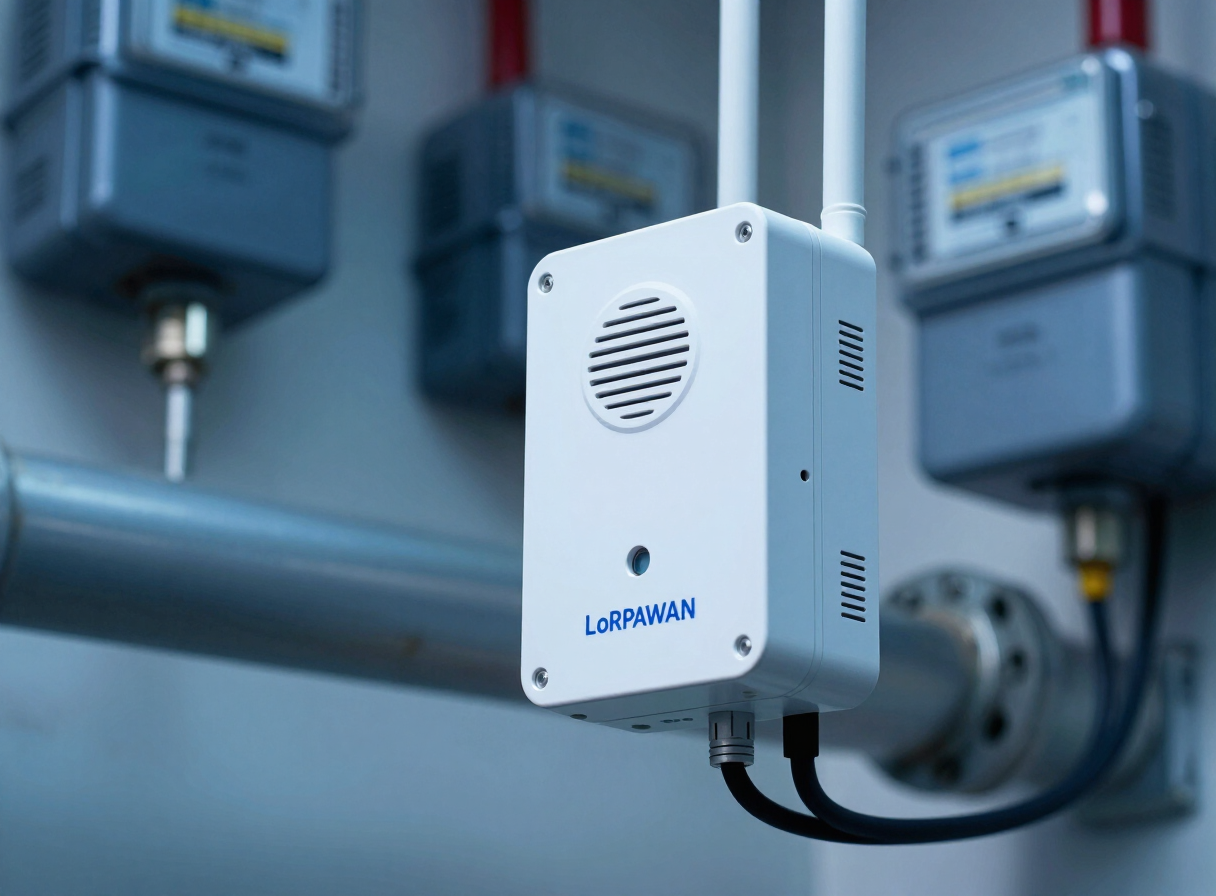
Wired vs wireless sub-metering: cost, speed and coverage
How wired sub-metering and wireless LoRaWAN metering compare on installation cost, disruption, scalability and long-term maintenance across large industrial estates.
Sub-metering is the foundation of any serious energy programme. The debate is usually about how to connect the meters: run cables back to a data concentrator, or transmit wirelessly. For a single new-build panel, wired metering can be tidy. For a live, sprawling industrial estate, the cost and disruption of cabling quickly dominates the project.
Wireless LoRaWAN metering removes that friction. Long-range, low-power radio reaches meters across large sites and outbuildings without new cabling, so measurement points can be added incrementally wherever insight is needed.
At a glance
- Wired metering means cabling, containment and downtime
- Wireless LoRaWAN meters install in minutes per point
- Wireless scales across sprawling sites and remote assets
- Battery-powered sensors run for years with low maintenance
- Both deliver accurate data; wireless removes the deployment friction
Wired sub-metering vs wireless LoRaWAN metering
| Consideration | Wired metering | Wireless LoRaWAN |
|---|---|---|
| Install per point | Hours — cabling and containment | Minutes — clamp-on and pair |
| Disruption | Isolations and downtime likely | Minimal, often live |
| Reach | Limited by cable runs | Kilometres across a site |
| Scalability | Costly to extend | Add points on demand |
| Maintenance | Cable faults, containment | Battery swaps every few years |
| Remote assets | Hard to reach | Ideal for outbuildings and yards |
The true cost of wired metering
The meter is rarely the expensive part — the labour, containment and downtime are. On live sites these dominate the budget and the programme timeline.
Labour and containment
Cable runs, trunking and terminations add hours of skilled labour per point.
Downtime risk
Isolating circuits for installation can interrupt production.
Hard to extend
Adding a meter later means revisiting cabling and containment.
Why wireless wins at scale
Across large estates the economics flip decisively toward wireless: faster rollout, lower cost per point and effortless expansion.
Minutes per point
Clamp-on CTs and pulse counters install without isolation in most cases.
Estate-wide reach
A few gateways cover an entire campus, including remote assets.
Grow as you learn
Add measurement exactly where the data reveals opportunity.
Is wireless metering as accurate as wired?
Yes. Accuracy comes from the meter and current transformer, not the communications method. LoRaWAN simply transmits the same measured data wirelessly.
How long do wireless sensor batteries last?
Typical LoRaWAN energy sensors run for several years on a single battery thanks to their low-power design and infrequent transmission.
Can wireless metering cover remote outbuildings?
Yes. LoRaWAN's long range makes it ideal for yards, outbuildings and remote assets that would be prohibitively expensive to cable.
Continue exploring.
Ready to make your estate measure itself?
Request an infrastructure audit and we will design a LoRaWAN energy-monitoring programme built for ISO 50001 readiness across the UK and Europe.
Choose how you would like to engage our team.
Every route below reaches our UK and EU enterprise engineers directly. Pick the one that fits where you are — no obligation, response within one working day.
Common questions
An engineer reviews your metering estate and site plans, then returns a scoped monitoring proposal — typically within one working day of the initial call. There is no cost or obligation.
Send an enquiry
Tell us about your estate and we will route you to the right engineer.